Start Your Journey to a Quiter Daily Routine.
A regular lead-up to a yoga session may be a soothing spot to begin – as well as any assistance that is already being provided – if stress and anxiety have been impacting your day to day existence.
In addition to the stress from work and deadlines and not getting the sleep that we need, many encounter stress from racing minds that don't chill and relax down at night. While stress itself can't be eliminated by practising yoga, yoga can provide tools for dealing with the ways in which your body and mind react to stress. Our classes are designed to provide a relaxing, structured approach to breath and movement taking place in a virtual classroom with an actual instructor.
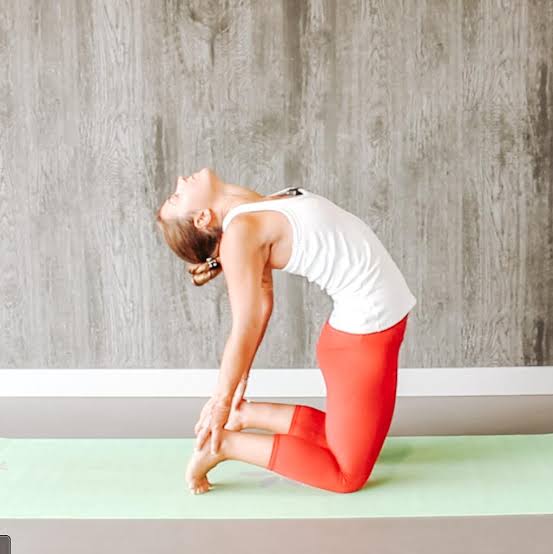
It is not possible to make relaxation happen by forcing it. Some individuals find it is best to start slowly with yoga for stress and anxiety – it's not a single day of deep breathing!
Stress is felt first in the body — such as in your shoulders, jaw, and breathing manner. Helpful yoga will relieve stress, and anxiety will help free up this tension at the beginning in order not to accumulate further.
One of the simplest positions of yoga that is particularly for dealing with anxiety is called 'Pranayama', which is practised with breath. When you sense you've slowed your breathing down, you'll find your mind has done the same.
Even if it takes five to ten minutes for a brief meditation or relaxation, it can help to settle a busy brain and help get into a more relaxed state throughout the day.
We've selected our yoga asanas for depression & anxiety that are gentle and restorative and not overwhelming.
These are poses and yoga exercises for anxiety in the form of quiet breathing, not rapid or accelerated movement.
A number of our yoga poses for anxiety are matched up straight with the breath, that is, the pose and the breath provide a calming effect through their combined action.
As a compliment to the many poses that are brain busy, for students whose minds need a break, we also offer restorative, supported poses that demand minimal commitment from the body – thus, the mind can rest.
We know that no two people are equally anxious, and we personalise our pace, breathing, movement style and relaxation method to fit in the moment we encounter each class.
We do not guarantee that any one class will place you in a calm state. With students repeatedly, Acharya Vivek reminds them that being aware of breath is a skill requiring a long, slow process and is not something which can be turned on. What we're working on here is awakening to our patterns of breath and tension, clearly, so we can return to this awareness later – when we have a stressful moment at work – not only while we're on the mat.
Small classes and personal attention – not a large class with no one paid attention to
Flexible scheduling across time zones
Real individual attention – small group sizes.
Teaching rooted in traditional yogic and Ayurvedic understanding
Sessions that follow your mood and don't go by a set script.
A regular lead-up to a yoga session may be a soothing spot to begin – as well as any assistance that is already being provided – if stress and anxiety have been impacting your day to day existence.
Yes—with regular practice and the aid of breathwork, the body and mind can over time respond more easily with calmness to stress.
Yes, our classes are “beginner” level, and we work at a comfortable pace.
The poses that are done slowly with a long holding time and taken in a way that allows for steady breathing tend to be the most calming and less fast paced.
Yes, students from many countries, across different time zones, are allowed to enrol in our live classes.
No. Yoga can be a helpful element in emotional wellbeing but cannot take the place of a mental-health profession. Whether treatment has been recommended by a qualified professional, please go ahead and continue any treatment.